HOW I USED TO EDIT MY FILMS
© 2011-2021 Antero Alli
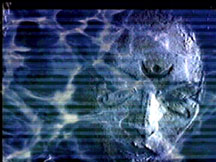
I'm thinking about the first human cinema experience, that prehistoric moment in a dark cavern where human and animal figures painted on the rock wall, jump to life when illuminated by the flicker of the hearth fire. In my romantic ideas, it’s a little like how I see editing the rough cut of my films: in my own cave-like room whose walls I painted black years ago for this very purpose.
Of all the many aspects of filmmaking -- writing, rehearsing, shooting, directing -- for me, editing remains the most creative. It's where the movie gets made. Though there is a screenplay, I remain open to discover the story within the story, the story that wasn’t my original plan but that wants to be told nevertheless. Sometimes, this demands experimenting with new ways to sequence the scenes to deviate from how they first appeared in my screenplay. If these new sequences can reveal the story within the story, the subtext, I go for it. Sometimes when the finished film screens for actors, their eyebrows arch as they gaze towards me with questioning eyes, “What movie were we making here?” Those who have acted in more than a few films eventually figure out that how little control they actually have, compared to what they can get away with onstage in live theatre.
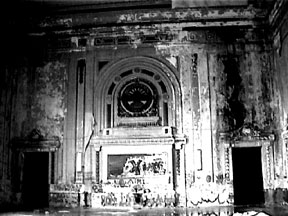
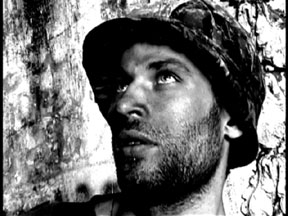
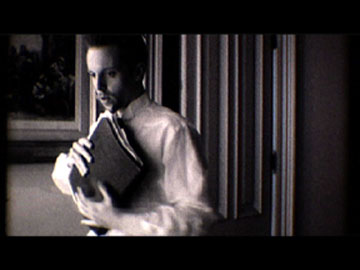
Jakob Bokulich in "Hysteria" (2002)
My edit method is rife with CHAOS (Crazy Hilarious Archaic Olde Skool); it’s how all my films and videos have been completed since 1990. Here are the seven steps I follow: 1) Whether I shoot on super-8 film or HD video, everything get transferred to mini-dv tape. 2) I then transfer all the footage from mini-dv to VHS tapes (V-H-S; you read that right) with the timecode recorded onscreen so I can identify and reference every frame I watch. 3) While reviewing the 15-20 VHS tapes, I write up a log listing all the takes I like best. 4) Using two video monitors, two VHS edit decks, one 1990 A/V mixer board,one CD player and one very dark room, I begin to edit the rough cut of my movie manually with no computers. 5) When my rough cut is done, I draw up an edit list with precise timecode for all the ins and outs of each shot and with notes. 6) I bring this edit list and all my tapes to Chris Odell who is adept in Final Cut Pro, a popular nonlinear edit program 7) Together, we assemble edit the whole movie, finesse the transitions, balance and sweeten the audio, apply color correction, and insert all the music and titles.
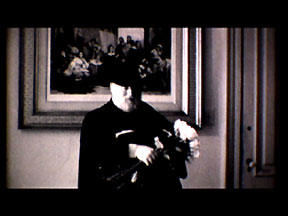
Slobodan Paitch and Lloyd Bricken in "The Greater Circulation" (2005)
When 90% of the work is already done before meeting the online editor, the final cost to me is a fraction of what it would have been had I not done the grunt work beforehand. If you do not edit yourself, editing a film can be the most expensive part of the filmmaking process and can significantly delay completion until “finishing funds” can be raised to pay the editor. I called this edit approach CHAOS after some filmmaker friends told me, in so many words, that I was Crazy Hilarious Archaic Olde Skool. They’re right and it works for me.
This time-intensive hands-on CHAOS process reminds me of the difference between typing on a typewriter and on a computer’s word processing program. It forces me to take my time and consider everything I do with utmost attention. No shortcuts. No easy escapes. This approach has also allowed me to complete every film I have started. Since most of my works are chiefly self-funded (though sometimes Angels have been known to flock in and lift my films up to the heavens), it’s how I have been able to afford making them.
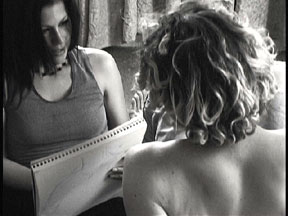
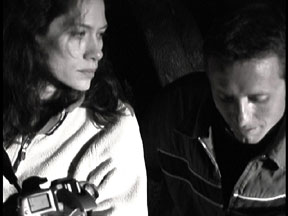
Susan Schramm & Dana
Bergeman, Carla Negri & Paul D' Addario
in "Roadkill" (2001)
After doing this for twenty years, the production value and quality of my films have reached standards much higher than I ever anticipated. This is due to many factors such as the increasing accessibility of advanced technology and my own ongoing development of skill with the lighting, the sound, the camerawork, and with directing actors. All of this has also had the effect of attracting a deeper talent pool along the way. For me, the actor’s performances remain paramount. It’s where the action starts and ends. From there, it’s all about bringing care and attention to the technical aspects of audio, picture, and the setting to best capture that elusive magical presence called cinema.
2021 AFTERWARD
Starting in 2020, I started editing my features and shorts on iMovie. With video tapes gone the way of the dodo bird, I load digital files from SD cards into my computer.